

Flag Football's Global Test Run
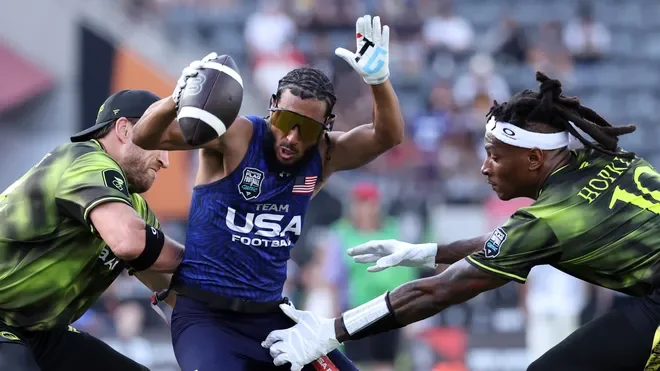
Team USA dominated the Flag Football Classic — which had to be moved from Riyadh to Los Angeles at the last minute, due to geopolitical concerns. (Photo from USA Today)
Guest article by Taylor Redick Wright
On March 21, the Fanatics Flag Football Classic gave fans and athletes an opportunity to preview Olympic flag football ahead of its 2028 debut. Organized as a partnership between Tom Brady, Fanatics, Fox Sports, and OBB Media, the event reflected the growing ecosystem around flag football that the NFL has invested heavily in building.
The original Riyadh location raised familiar questions about Saudi Arabia's use of major sports events to improve its international image. It was then relocated to Los Angeles with 12 days’ notice after security concerns surfaced from fallout of the U.S. and Israel launching attacks in nearby Iran, leading the U.S. Department of State to advise Americans to reconsider travel to Saudi Arabia. The relocation was managed, but it illustrated a challenge that extends beyond any single event. As the NFL pours resources into growing flag football globally, the sport is increasingly being showcased in geopolitical environments that nobody fully controls.
As a driver of American football's global growth, the NFL's international regular season play dates back to 2005, with the first game held outside of the U.S. in Mexico City. The NFL started its current International Series in October 2007, and this year, the League is scheduled to hold nine games across Melbourne, Rio de Janeiro, Paris, Mexico City, London, Munich, and Madrid. Supporting that footprint is a broader set of NFL initiatives, including the former European development league known as the World League of American Football, the African talent pipeline NFL Africa, the International Player Pathway for scouting and training international athletes, and the NFL FLAG program, which has distributed kits to students in Germany, Mexico, Canada, the United Kingdom, and China.
Central to the NFL's international programming is flag football, a non-contact version of the game that has grown significantly across genders and age groups, and is now played in over 100 countries. Its inclusion in the 2028 Olympic Games marks a significant milestone, one that will bring the sport to new audiences across the world and broaden the NFL's international presence further. The NFL is also hoping to have a few of its stars on the USA Olympic Flag Football Team...which might have hit a setback at this competition, as the professional flag football players dominated the NFL players, winning 82–27 across multiple games against teams featuring the likes of Joe Burrow, Saquon Barkley, and Stefon Diggs. But that's a question for down the road. For now, the League's combined expansion efforts reflect a broader shift toward building an international athletic pipeline and audience, and with that growth, the complexity of operating internationally only increases.
That an event celebrating flag football had to move cities less than two weeks out due to global tensions is a preview of the environment the NFL may be expanding into. The Classic featured a diverse roster of current and former NFL players, Team USA's flag football athletes, and other competitors, all of whom found themselves navigating a situation shaped by forces well outside the sport. As the NFL sends its players into more countries and more complex environments, understanding the political landscape of host locations and ensuring players are well informed will become an increasingly important part of operating internationally.
That challenge extends beyond events the NFL organizes directly. The Fanatics Flag Football Classic was not an NFL event, but the issues it surfaced should be of concern to the League regardless. A growing global footprint means growing exposure to a world the NFL cannot script, and learning to navigate that well will matter as much as any game played abroad.
If you’re interested in writing a guest article for CenterCircle, contact us.
